


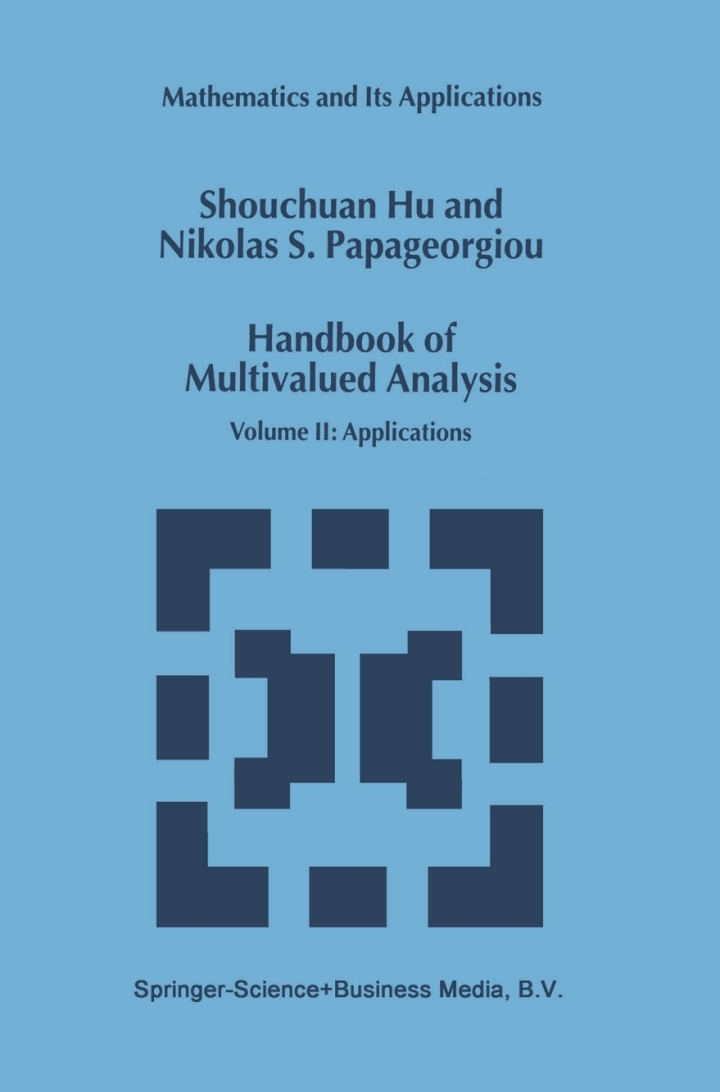
Handbook of Multivalued Analysis: Volume II: Applications eBook
Original price was: $159.00.$29.00Current price is: $29.00.
Delivery: Can be download immediately after purchasing. For new customer, we need process for verification from 30 mins to 12 hours.
Version: PDF/EPUB. If you need EPUB and MOBI Version, please contact us.
Compatible Devices: Can be read on any devices.
In volume I we developed the tools of “Multivalued Analysis. ” In this volume we examine the applications. After all, the initial impetus for the development of the theory of set-valued functions came from its applications in areas such as control theory and mathematical economics. In fact, the needs of control theory, in particular the study of systems with a priori feedback, led to the systematic investigation of differential equations with a multi valued vector field (differential inclusions). For this reason, we start this volume with three chapters devoted to set-valued differential equations. However, in contrast to the existing books on the subject (i. e. J. -P. Aubin – A. Cellina: “Differential Inclusions,” Springer-Verlag, 1983, and Deimling: “Multivalued Differential Equations,” W. De Gruyter, 1992), here we focus on “Evolution Inclusions,” which are evolution equations with multi valued terms. Evolution equations were raised to prominence with the development of the linear semigroup theory by Hille and Yosida initially, with subsequent im portant contributions by Kato, Phillips and Lions. This theory allowed a successful unified treatment of some apparently different classes of nonstationary linear par tial differential equations and linear functional equations. The needs of dealing with applied problems and the natural tendency to extend the linear theory to the nonlinear case led to the development of the nonlinear semigroup theory, which became a very effective tool in the analysis of broad classes of nonlinear evolution equations.
This is a digital product.
Handbook of Multivalued Analysis: Volume II: Applications is written by Shouchuan Hu; Nikolaos S. Papageorgiou and published by Springer. The Digital and eTextbook ISBNs for Handbook of Multivalued Analysis are 9781461546658, 1461546656 and the print ISBNs are 9780792361640, 0792361644. Additional ISBNs for this eTextbook include 9781461371113.
Related products


Trending

Trending

Bestsellers


Trending

Bestsellers

Bestsellers