
Delivery: Can be download immediately after purchasing. For new customer, we need process for verification from 30 mins to 12 hours.
Version: PDF/EPUB. If you need EPUB and MOBI Version, please contact us.
Compatible Devices: Can be read on any devices.
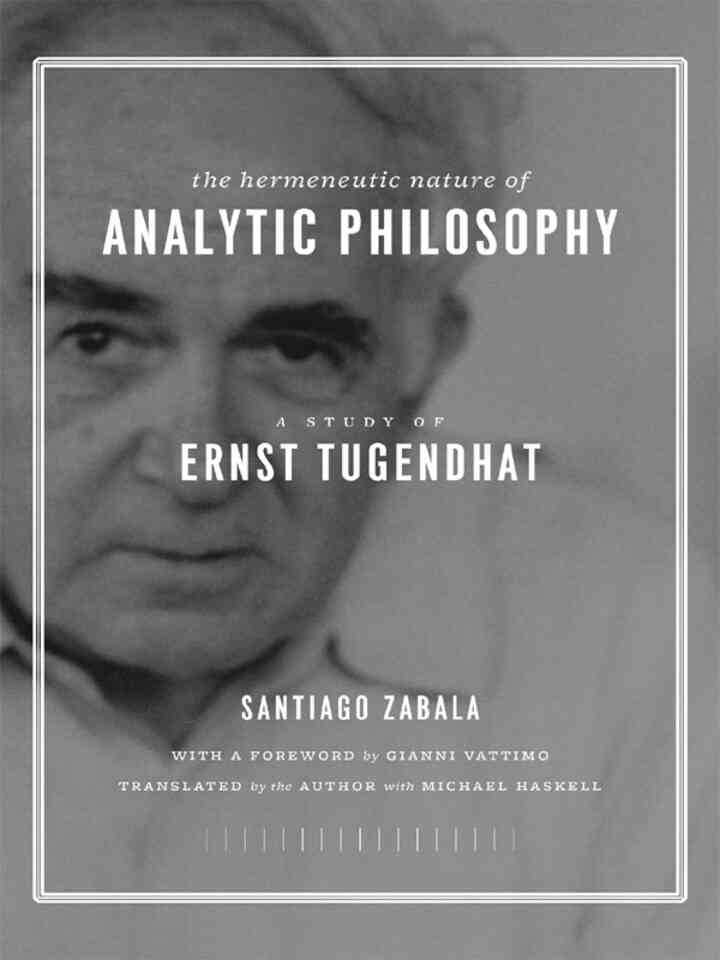
The Hermeneutic Nature of Analytic Philosophy
A Study of Ernst Tugendhat
Contemporary philosopher—analytic as well as continentaltend to feel uneasy about Ernst Tugendhat, who, though he positions himself in the analytic field, poses questions in the Heideggerian style. Tugendhat was one of Martin Heidegger’s last pupils and his least obedient, pursuing a new and controversial critical technique. Tugendhat took Heidegger’s destruction of Being as presence and developed it in analytic philosophy, more specifically in semantics. Only formal semantics, according to Tugendhat, could answer the questions left open by Heidegger. Yet in doing this, Tugendhat discovered the latent “hermeneutic nature of analytic philosophy”its post-metaphysical dimension—in which “there are no facts, but only true propositions.” What Tugendhat seeks to answer is this: What is the meaning of thought following the linguistic turn? Because of the rift between analytic and continental philosophers, very few studies have been written on Tugendhat, and he has been omitted altogether from several histories of philosophy. Now that these two schools have begun to reconcile, Tugendhat has become an example of a philosopher who, in the words of Richard Rorty, “built bridges between continents and between centuries.” Tugendhat is known more for his philosophical turn than for his phenomenological studies or for his position within analytic philosophy, and this creates some confusion regarding his philosophical propensities. Is Tugendhat analytic or continental? Is he a follower of Wittgenstein or Heidegger? Does he belong in the culture of analysis or in that of tradition? Santiago Zabala presents Tugendhat as an example of merged horizons, promoting a philosophical historiography that is concerned more with dialogue and less with classification. In doing so, he places us squarely within a dialogic culture of the future and proves that any such labels impoverish philosophical research.
This is a digital product.
The Hermeneutic Nature of Analytic Philosophy: A Study of Ernst Tugendhat is written by Santiago Zabala and published by Columbia University Press. The Digital and eTextbook ISBNs for The Hermeneutic Nature of Analytic Philosophy are 9780231512978, 023151297X and the print ISBNs are 9780231143882, 0231143885.

Fast Facts for Curriculum Development in Nursing eBook
ggplot2 eBook
Bring Your Own Devices (BYOD) Survival Guide eBook
Microsoft Office Access 2007 Step by Step eBook
Everything Happens for a Reason eBook
Parents as Partners in Education eBook
The Skew-Normal and Related Families eBook
Access 2007 eBook
Cengage Advantage Books: Bioethics in a Cultural Context: Philosophy, Religion, History, Politics eBook 


Reviews
There are no reviews yet.