


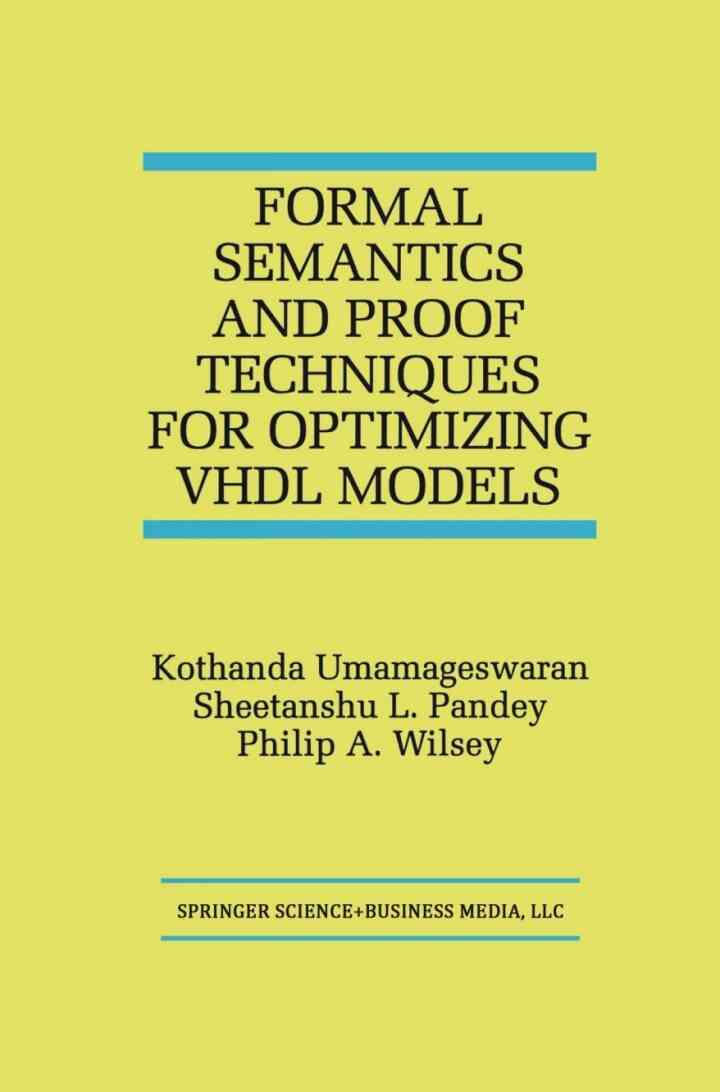
Formal Semantics and Proof Techniques for Optimizing VHDL Models eBook
Original price was: $99.00.$17.00Current price is: $17.00.
Delivery: Can be download immediately after purchasing. For new customer, we need process for verification from 30 mins to 12 hours.
Version: PDF/EPUB. If you need EPUB and MOBI Version, please contact us.
Compatible Devices: Can be read on any devices.
Formal Semantics and Proof Techniques for Optimizing VHDL Models presents a formal model of VHDL that clearly specifies both the static and dynamic semantics of VHDL. It provides a mathematical framework for representing VHDL constructs and shows how those constructs can be formally manipulated to reason about VHDL. The dynamic semantics is presented as a description of what the simulation of VHDL means. In particular it specifies what values the signals of a VHDL description will take if the description were to be executed. An advantage of the approach is that the semantic model can be used to validate different simulation algorithms. The book also presents an embedding of the dynamic semantics in a proof checker which is then used to prove equivalences of classes of VHDL descriptions. Formal Semantics and Proof Techniques for Optimizing VHDL Models is written for hardware designers who are interested in the formal semantics of VHDL.
This is a digital product.
Formal Semantics and Proof Techniques for Optimizing VHDL Models is written by Kothanda Umamageswaran; Sheetanshu L. Pandey; Philip A. Wilsey and published by Springer. The Digital and eTextbook ISBNs for Formal Semantics and Proof Techniques for Optimizing VHDL Models are 9781461551232, 1461551234 and the print ISBNs are 9780792383758, 0792383753. Additional ISBNs for this eTextbook include 9781461373315.
Related products


Bestsellers

Bestsellers

Bestsellers
Bestsellers

Bestsellers

Bestsellers