
Delivery: Can be download immediately after purchasing. For new customer, we need process for verification from 30 mins to 12 hours.
Version: PDF/EPUB. If you need EPUB and MOBI Version, please contact us.
Compatible Devices: Can be read on any devices.
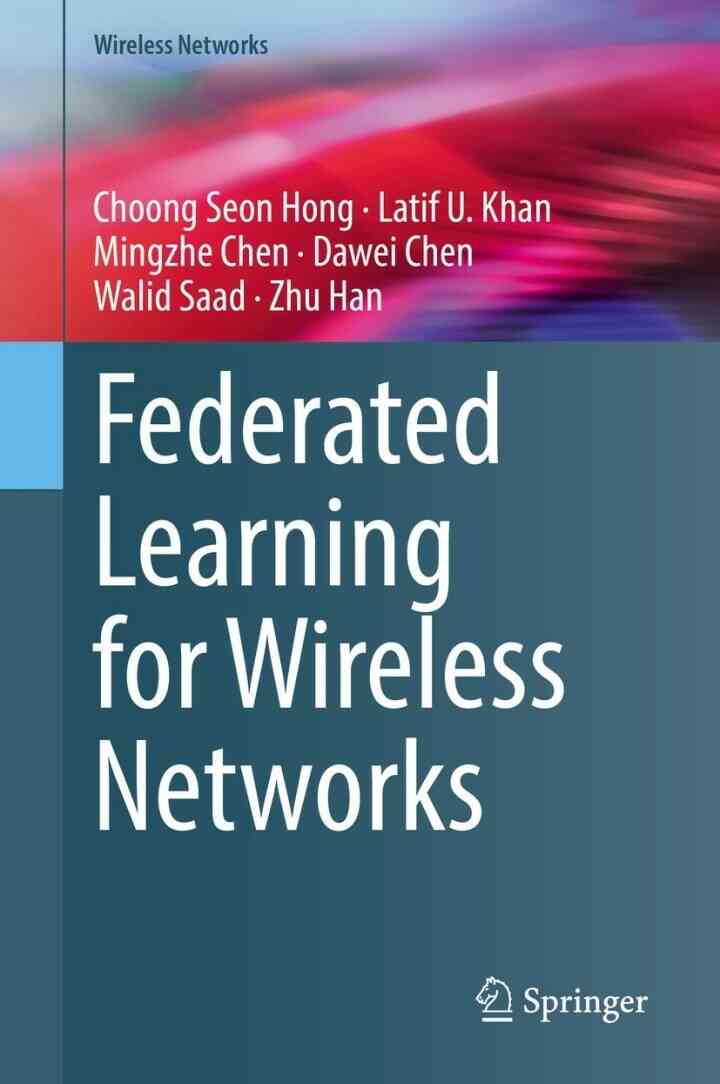
Recently machine learning schemes have attained significant attention as key enablers for next-generation wireless systems. Currently, wireless systems are mostly using machine learning schemes that are based on centralizing the training and inference processes by migrating the end-devices data to a third party centralized location. However, these schemes lead to end-devices privacy leakage. To address these issues, one can use a distributed machine learning at network edge. In this context, federated learning (FL) is one of most important distributed learning algorithm, allowing devices to train a shared machine learning model while keeping data locally. However, applying FL in wireless networks and optimizing the performance involves a range of research topics. For example, in FL, training machine learning models require communication between wireless devices and edge servers via wireless links. Therefore, wireless impairments such as uncertainties among wireless channel states, interference, and noise significantly affect the performance of FL. On the other hand, federated-reinforcement learning leverages distributed computation power and data to solve complex optimization problems that arise in various use cases, such as interference alignment, resource management, clustering, and network control. Traditionally, FL makes the assumption that edge devices will unconditionally participate in the tasks when invited, which is not practical in reality due to the cost of model training. As such, building incentive mechanisms is indispensable for FL networks. This book provides a comprehensive overview of FL for wireless networks. It is divided into three main parts: The first part briefly discusses the fundamentals of FL for wireless networks, while the second part comprehensively examines the design and analysis of wireless FL, covering resource optimization, incentive mechanism, security and privacy. It also presents several solutions based on optimizationtheory, graph theory, and game theory to optimize the performance of federated learning in wireless networks. Lastly, the third part describes several applications of FL in wireless networks.
This is a digital product.
Federated Learning for Wireless Networks is written by Choong Seon Hong; Latif U. Khan; Mingzhe Chen; Dawei Chen; Walid Saad; Zhu Han and published by Springer. The Digital and eTextbook ISBNs for Federated Learning for Wireless Networks are 9789811649639, 9811649634 and the print ISBNs are 9789811649622, 9811649626.

Codependent No More Workbook eBook
GM G-Body Performance Upgrades 1978-1987 eBook
ggplot2 eBook
Understanding Medical Coding: A Comprehensive Guide eBook
Introduction to English Morphology eBook
The Ultimate Pet Health Guide eBook
You Are Not a Gadget eBook
Microsoft Office Excel 2007 Step by Step eBook
Cultivo de Maconha: O Guia para o Cultivo Indoor de Maconha para Uso Medicinal e Pessoal eBook
Ericksonian Approaches: A Comprehensive Manual eBook 


Reviews
There are no reviews yet.